
Foreclosures and Short Sales Explained: A Twin Cities Buyer Guide
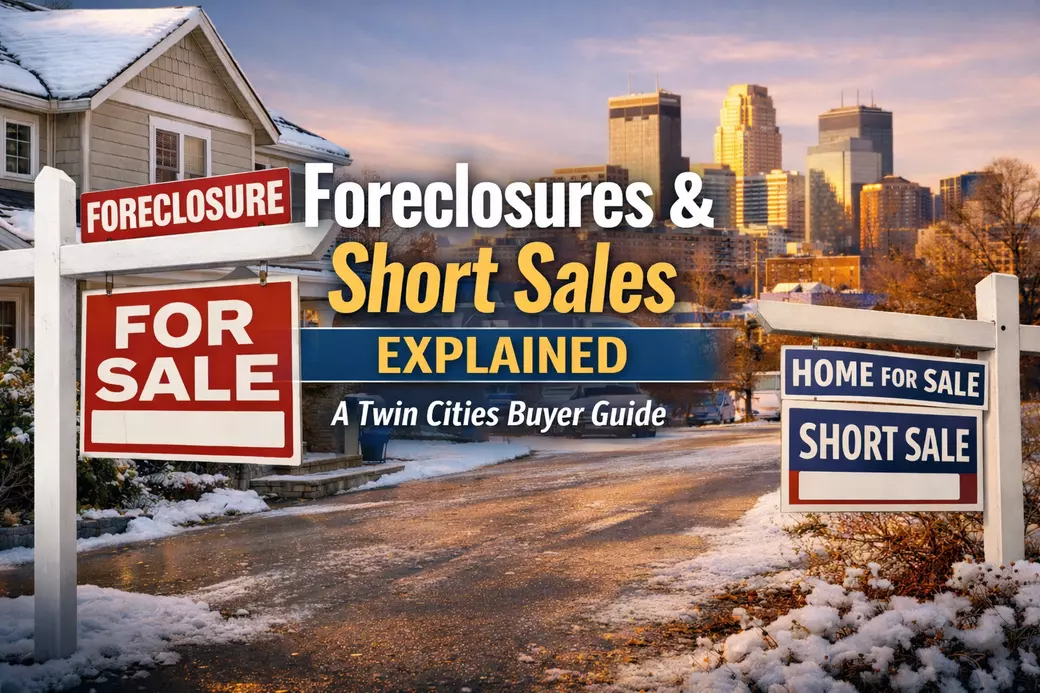
Foreclosures and Short Sales Explained: A Twin Cities Buyer Guide
Foreclosures and short sales can create opportunity for buyers—but they also come with added complexity, especially here in the Twin Cities market. If you’ve heard these terms and aren’t quite sure what they really mean, you’re not alone.
Below, we break down how foreclosures and short sales work in Minnesota, what to expect as a buyer, and who these properties tend to be a good fit for.
What Is a Foreclosure?
A foreclosure is the forced sale of a property after the owner defaults on their mortgage. Once the foreclosure process is complete, the bank or lender becomes the seller—not the homeowner.
- The lender owns the property and controls the sale.
- These homes are often referred to as REO properties (Real Estate Owned).
- Many foreclosures in the Twin Cities have been vacant for months before listing.
- Winter listings are commonly winterized to protect plumbing and mechanical systems.
Before listing, the lender orders appraisals and sets the price based on market data. The final accepted price depends on:
- The number of offers received
- Current Twin Cities market conditions
- The lender’s motivation and internal guidelines
Because you’re dealing with a bank rather than a homeowner, the process is more structured and less flexible than a traditional sale.
What Is a Short Sale?
A short sale occurs when a homeowner owes more on their mortgage than the home is worth and cannot sell it for enough to cover the loan balance.
- The homeowner is usually still living in the property.
- The seller must demonstrate a verified financial hardship.
- The lender must agree to accept less than what is owed.
Many short sales involve more than one lender. In those cases, every lender involved must approve the discounted payoff, which is where delays often occur.
Once a buyer and seller agree on an offer:
- The sale becomes contingent upon lender approval.
- The lender orders appraisals and reviews the seller’s hardship.
- The approval process can take several months.
- Any new offers are typically held as backup offers.
Short sales do not always close. In some cases, the lender may reject all offers and allow the property to proceed to foreclosure.
Lien & HOA Considerations (Especially in Minnesota)
Even after lender approval, other lien holders can impact or delay closing.
- Second mortgages must also approve the sale.
- Townhome and condo associations in Minnesota typically require unpaid dues or assessments to be paid at closing.
- HOAs are rarely willing to forgive outstanding balances.
Identifying all liens early is critical. Unresolved liens can cause last-minute surprises or prevent closing altogether.
Patience Is Required
When it comes to lender-mediated properties, patience is not optional.
No patience = no short sale.
Delays are common due to:
- Lenders operating outside of Minnesota and in different time zones
- Multiple bank departments reviewing the file
- Strict internal systems and investor guidelines
If you need a firm closing date or quick possession, a foreclosure or short sale may not be the best fit. Lenders strongly prefer buyers with flexible timelines.
It’s also important to note that many lender-mediated properties are sold as-is. While some homes are in solid condition, others may require repairs or updates.
Frequently Asked Questions
Are foreclosures and short sales common in the Twin Cities?
They exist, but they are a smaller portion of the market compared to traditional sales. Opportunities tend to be more limited in strong seller markets and more common during market shifts.
Can I get a good deal on a foreclosure or short sale?
Sometimes—but not always. Pricing is based on market value, condition, and lender strategy. Competition can still be strong, especially for well-located Twin Cities properties.
Do foreclosures or short sales take longer to close?
Yes. REOs generally close faster than short sales, but both typically take longer than a traditional transaction.
Are these homes sold as-is?
In most cases, yes. Lenders rarely make repairs and often limit disclosures.
Is this a good option for first-time or time-sensitive buyers?
Usually not. These transactions are better suited for buyers who have flexibility, patience, and realistic expectations.
Our Perspective as Your Buyer Advocates
At the Sandy Erickson Real Estate Team, we believe foreclosures and short sales can be a good fit for the right buyer—but only with full transparency and proper guidance.
We provide buyers with all known information to help protect their interests and navigate the added risks that come with lender-mediated properties. Even with experience and preparation, these transactions can involve uncertainty we cannot fully control or predict.
Understanding Minnesota timelines, sheriff’s sale processes, and redemption periods is critical. Comfort with risk and flexibility is essential.
If you’re considering a foreclosure or short sale in the Twin Cities, having the right expectations—and the right team—makes all the difference.
Categories
Recent Posts






LEAVE A REPLY

Realtor & Team Leader | License ID: 20359558
+1(651) 269-3487 | sandy@sandyerickson.com